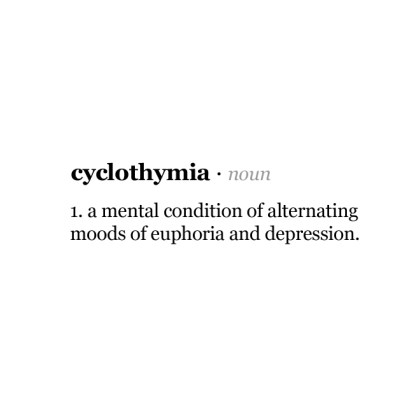
I was 19 when I was diagnosed as being cyclothymic, during the years it affected me my life at times could be simply unbearable. At 21 now I firmly believe I have overcome the worst of this illness, I haven’t had a suicidal thought in over a year and the way that I see things has improved remarkably. I’ve wrote about what I did during the period it was at it’s worst, hoping that if you too are suffering that you may find hope or relate to what I did.
What is cyclothymia?
For those who don’t know or understand what cyclothymia is, it’s a type of chronic mood disorder which is considered to be a mild form of bipolar disorder. Sufferers face numerous and various mood swings and depressive states followed by a hypomanic state. It is becoming more common amongst people but not as frequent as bipolar disorder, although it is believed that 15-50% of cases may then lead to the diagnostic criteria for bipolar 1 or 2. It is just as common in men as it is women, however it is generally believed that women seek help more often than men. The exact cause of cyclothymia is unknown at the moment, although there may be a genetic component. A study showed that identical twins are 2-3 times more likely to be affected if one of the siblings suffers from it, and it is also known that it often occurs together within families.
What do sufferers endure?
As stated earlier, sufferers usually go through depressive and hypomanic states. Below are just a number of examples of the different types of mindsets, emotions, habits that sufferers go through during each episode.
Depressive state – difficulty making decisions, problems concentrating, poor memory recall, self criticism, low self esteem, pessimism, apathy, constant sadness helplessness, hopelessness, social withdrawal, lack of sexual desire, quick temper, poor judgement, fatigue, insomnia, appetite change and sleepiness.
Hypomanic state – euphoria, Unusual good mood, racing thoughts, extreme optimism, inflated self esteem, aggressive or hostile behaviour, agitation, risky behaviour, spending sprees, increased drive to perform or achieve goals, easily distracted, decreased need for sleep and lack of consideration for others.
There are much more other emotions/mindsets that are linked to cyclothymia, this is just a short summary.
Practices I put in place
I struggled to cope for around a year and a half, pretty much the full time before my diagnosis. When I was diagnosed however, I began to research and look to others who were/had been through it. The Internet can be a massive help, there are literally hundreds of people who post blogs/post questions on forms and there is always someone trying to offer some advice. As Well as practices you can do yourself there are a few treatments available, lithium is quite a common method of treatment as well as drugs such as carbamazepine, oxcarbazepine or sodium valproate. CBT has also been known to be quite an effective therapy. Whether it was my pride believing I didn’t need any help, or I was too embarrassed to ask I never got nor seeked professional help.
Writing – when I had began to research, I saw quite a few people had recommended writing as part of a therapy. There are many different forms of writing you can do, like one woman had said her husband used to write down everything he was feeling and what was on his mind in a little book. They would then read over the book and see if there was anything they could do which would help, or to prevent something from happening again. Another person would write blog posts and another would write novels, using the depressive mindset as a positive to write deep and emotional storylines and themes. I myself however began to write music when I was at a low. I would write raps about how I felt, how I thought and what I thought. Without a doubt I wrote some of my best lyrics when I was in a depressive state. My first song I ever released was about depression, which got people noticing me throughout the whole Scottish rap scene. Another one of my releases about suicide, a concept based on some of my horrible thoughts became my greatest release. I gained countless plays on local radio, from Glasgow and the West to across the pond. People would mail me telling me they couldn’t stop crying listening to it, others would tell me how much they could relate to it and how they too had experienced the same thoughts. I was never too keen on my own music though, which is why I never really took it serious. But the fact I managed to connect to so many people with what I was going through was a sense of achievement, also a great reminder that I wasn’t alone with my struggles.
I would say writing is one of the most effective and productive ways in coping with cyclothymia.
One of the greatest things to remember as a cyclothymia sufferer, is that after your depressive state a hypomanic state will follow. I used this to the full of my advantage. Whenever I was upset, crying, angry, going through one of the rough patches I always told myself that in a short while I was going to be a lot different. I convinced myself to wait out my depressive episode and anticipate the energy, motivation and completely different mindset which would soon follow. Any goals, ideas, pretty much anything positive and progressive I had I would act on in my hypomanic states. From publishing one of my songs to booking a getaway, I would do this whilst in a hypomanic state. You can achieve so much in such a short space of time, which is why I would encourage you to try and view the hypomanic state as a gift rather than a curse.
In June 2013 Stephen Fry wrote a piece on his struggles with cyclothymia. Stephen Fry is a hugely intelligent and successful man, and although I don’t necessarily agree with a few of his views and opinions it doesn’t take away the fact that the man has achieved so much whilst battling this illness. He alone should be proof that you can progress and gain so much without cyclothymia holding you back.
It’s been over a year since I last had a major depressive episode, although I still have my bad days I am now in a better frame of mind than I ever was. I see things in a different perspective and I’m also hopeful and ambitious. I pray that one day they understand cyclothymia a lot better, find out what causes it and how to prevent/stop it. Until that day though, you just gotta keep fighting on. Dark and good days will both come and pass, the best thing you can do is to try and channel all those negative emotions and thoughts into something positive as hard as it may be. You can overcome the worst of this, I know this because I have. I hope that you conquer this illness one day, just please remember you are not alone. If you’re having one of the bad days please talk to someone on one of the online forms or drop me a mail at outsideofthewell@outlook.com.

 outsideofthewell